
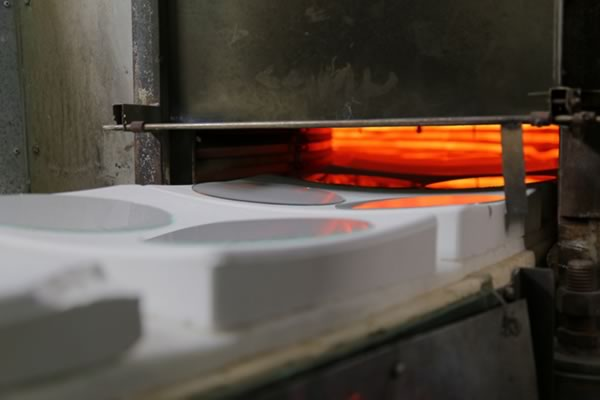
On the line, that hairline crack in tempered glass tends to show up after heating, when the thermal stress finally gets away from you. You run the furnace, hit the setpoints, and still you lose yield to spontaneous breakage. The answer isn’t more heat. It’s heat you can control.
What matters, technically
We built the infrared lamp for glass crack control around short-wave NIR elements in a quartz envelope. The goal is surface-dominant heating, fast, with minimal convection. The wavelength profile is matched to glass emissivity, so the energy goes where it needs to—right into the surface layer—without driving the bulk too hot. Output density is engineered to give a repeatable thermal profile across the ribbon, so temperature distribution is even and stress behavior stays predictable. Specs are straightforward: standard voltages, a compact lamp body, and terminals built for industrial duty. The response tracks your setpoint quickly, and repeatability is tight cycle after cycle.
Why it works in tempering and bending
In tempering and bending, the make-or-break moment is the transition through the softening range. If the thermal field has hot spots or lags, the glass expands unevenly, and those micro-cracks can get forced open. Our lamps smooth that transition, giving you a consistent soak across the entire sheet. The payoff is fewer rejects, fewer surprise fractures, and a line that keeps its pace. Energy use drops because the lamp heats directly and cycles fast. Downtime drops because the module is built for continuous operation. For high-throughput glass plants, that means more good glass per shift.
What you need to know
Installation is simple, but alignment is not optional. The lamp has to be positioned to match the glass path and the existing thermal zones—even a few millimeters off and the profile drifts. Give yourself a short warm-up to stabilize output before you lock in the process window. And while the lamp works with many standard fixtures, confirm mounting, reflector geometry, and cooling airflow for your specific machine—especially when you’re retrofitting an OEM heating section. Schedule the changeover during a planned stop, then run a validation pass on your thickest and thinnest glazing to set the final parameters.